Weakened Spin-Orbit Coupling Drives Temperature-Induced Phase Transition
A research article published in Newton (Cell Press) reports that increased temperature weakens spin-orbit coupling (SOC), driving a transition from topological to normal insulating states in the topological insulator Bi2Se3. The research suggests that SOC could be tuned by the temperature knob for controlling topological properties of materials. The research was led by Prof. Yi-Yang SUN from the Shanghai Institute of Ceramics, Chinese Academy of Sciences (SICCAS). The first author of the paper is Lingyan LU, a PhD candidate at SICCAS.
SOC is a key interaction underlying many physical phenomena, including the formation of topological insulators. As a relativistic effect, SOC is generally perceived to be determined by the constituent atomic species of a material and not to be strongly correlated with temperature. To investigate its temperature dependence, the researchers combined first-principles calculations with ab initio molecular dynamics simulations to track the evolution of electronic structure of Bi2Se3 across the range of 0-900 K.
Results show that increasing temperature progressively reduces the SOC-induced band gap correction by up to 0.19 eV over this range, suppressing the band inversion required for topological order. By sampling molecular dynamics trajectories, the researchers observed that topologically trivial snapshot structures emerge above 500 K, with their population quickly rising at higher temperatures. Surface spectral function calculations confirm the loss of gapless Dirac cones in these structures.
By separating the effects of thermal lattice expansion from those of structural disorder, the researchers showed that lattice expansion alone cannot account for the observed transition from a topological insulator to a normal insulator. Instead, the temperature-induced weakening of SOC is identified as the primary driving force behind the transition. This phenomenon was further validated in two other typical topological insulators, Bi2Te3 and Sb2Te3, where SOC was similarly found to weaken with increasing temperature.
This work breaks with the general perception that SOC is intrinsic to a material and mainly determined by its atomic species. Consequently, the SOC strength could become a tuning knob to control materials’ electronic property for potential applications in spintronics and quantum computing.
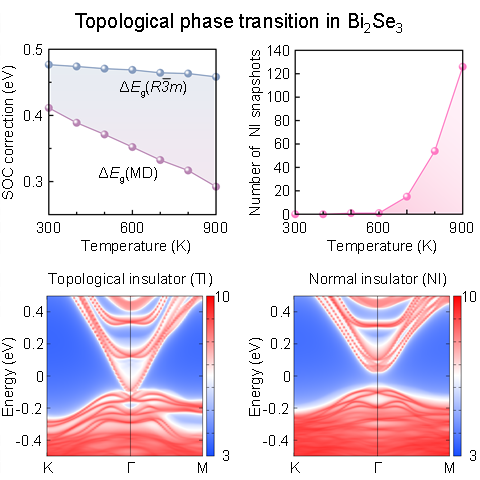
Figure 1. Evolution of the SOC correction to the Bi2Se3 band gap (ΔEg) with temperature, which drives a topological insulator (TI) to normal insulator (NI) transition. The transition is corroborated by the loss of gapless Dirac cones in the surface spectral function.
Links: https://doi.org/10.1016/j.newton.2026.100621
Contact: Yi-Yang Sun
Shanghai Institute of Ceramics, Chinese Academy of Sciences
E-mail: yysun@mail.sic.ac.cn
Published online: July 30, 2026