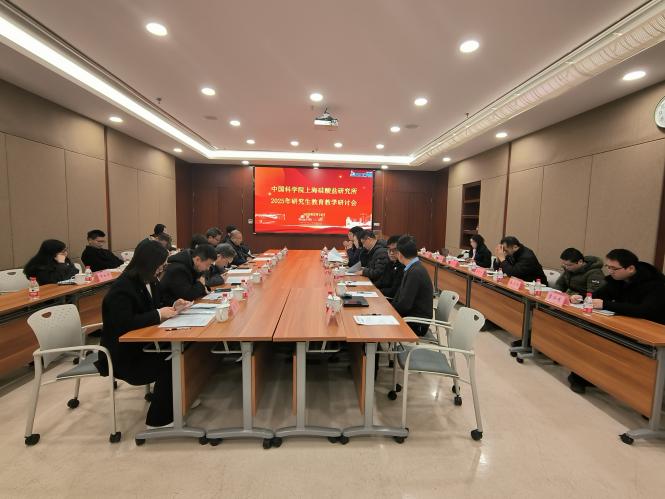
SICCAS Convenes 2025 Education and Teaching Seminar
On February 14, the Shanghai Institute of Ceramics, Chinese Academy of Sciences (SICCAS), held a seminar on education and teaching. Deputy Director Shi Xun attended the meeting and delivered a speech. Over 20 supervisors participated in the seminar, which was presided over by Lu Caifei, Deputy Director of the Graduate Department.
Researcher Chen Hangrong delivered a report titled Reflections and Insights on Graduate Teaching. Chen Hangrong is responsible for teaching the course Bio-nanomaterials. Based on the multidisciplinary nature of the course and her own research experience, she self-compiled the syllabus and lecture notes. She shared her insights on how to further improve teaching quality, strengthen students' awareness of academic research through coursework, cultivate their innovative thinking, and promote interdisciplinary integration.
Zhao Xueying from the Graduate Department presented a work report on graduate education and teaching. She provided a detailed overview of the requirements for graduate coursework, the status of graduate course teaching in 2024, the teaching reform initiatives of the University of Chinese Academy of Sciences (UCAS), textbook compilation efforts, and the 2025 graduate course schedule.
The participants engaged in an in-depth discussion on the institute's teaching work. They fully affirmed the achievements made in graduate teaching in recent years and shared their experiences, insights, and reflections on teaching models, objectives, content, textbook compilation, and teaching supervision. All agreed that emphasis should be placed on the design of teaching sessions during classroom instruction, and that teaching quality should be improved by selecting classic cases and adopting multimedia-assisted teaching methods. They also suggested that disciplines with mature conditions could compile or publish textbooks, and that teaching supervision should be carried out to further enhance the overall teaching level.
Shi Xun delivered the concluding speech. He expressed heartfelt gratitude to the graduate supervisors for their hard work and dedication to teaching. He noted that in the context of graduate education in the new era, the goal is to cultivate high-end talents with innovative capabilities and scientific research literacy, who will become the core force driving technological progress. Through systematic coursework, students can master cutting-edge theories and technologies, keep abreast of the latest research trends, and are expected to promote breakthroughs in frontier science and technology. Course teaching must be closely aligned with national strategic needs to cultivate high-end talents who meet national development goals, serve major national science and technology projects, and help seize the commanding heights of science and technology.
The seminar not only provided a platform for participants to exchange ideas and learn from one another, but also further clarified the goals of graduate education and teaching at the institute, playing a positive role in promoting the formation of a teaching model with the institute's own distinctive characteristics.