New Strategy Dramatically Enhances Light Output in Halide Scintillators
A research team at the Shanghai Institute of Ceramics, Chinese Academy of Sciences (SICCAS), has achieved a key breakthrough in scintillation materials, developing a new strategy that dramatically enhances light output through structural modulation. The findings were published in Research.
Led by Professor Yuntao WU, the team created a novel scintillation material, (Cs₈Cu)Y₃Cl₁₈, by introducing monovalent copper ions (Cu⁺) into a zero-dimensional Cs₃YCl₆ matrix. This structural evolution reorganizes the original light-emitting units into new “paddle-wheel” shaped configurations, converting previously delocalized exciton states into highly localized self-trapped exciton states. This transformation significantly increases the energy barrier that prevents non-radiative quenching—a process that typically causes light loss when excitons interact with defects in the material.
Scintillators are core components in detection systems used for medical imaging, security screening, and industrial inspection. They work by converting ionizing radiation (such as X-rays or gamma rays) into visible light. Traditional scintillators often suffer from efficiency losses because the excited carriers tend to migrate freely through the material, making them vulnerable to defects that cause non-radiative quenching.
The team’s new approach addresses this fundamental challenge. By confining excitons tightly within the material’s structure, they effectively suppress these losses. Experimental results show that (Cs₈Cu)Y₃Cl₁₈ exhibits approximately 460% higher scintillation light yield compared to the original Cs₃YCl₆, while maintaining extremely low afterglow and excellent thermal stability.
Flexible imaging screens fabricated from this material successfully achieved high spatial resolution radiation imaging at both room temperature and elevated temperatures, demonstrating its practical potential for applications in challenging environments.
This research builds on the team’s previous work on confined exciton luminescent scintillators, including Cs₃Cu₂I₅, Cs₃Cu₂I₅:Tl, and Cs₅Cu₃Cl₆I₂. The team had previously proposed the “exciton capture scintillation enhancement mechanism” and the “energy transfer near-infrared scintillation mechanism.” This latest breakthrough offers new ideas for designing high-light-yield scintillation materials through exciton confinement manipulation.
The research was supported by the National Key Research and Development Program, the National Natural Science Foundation of China, and the Youth Team Program for Stable Support in Basic Research Fields of the Chinese Academy of Sciences.
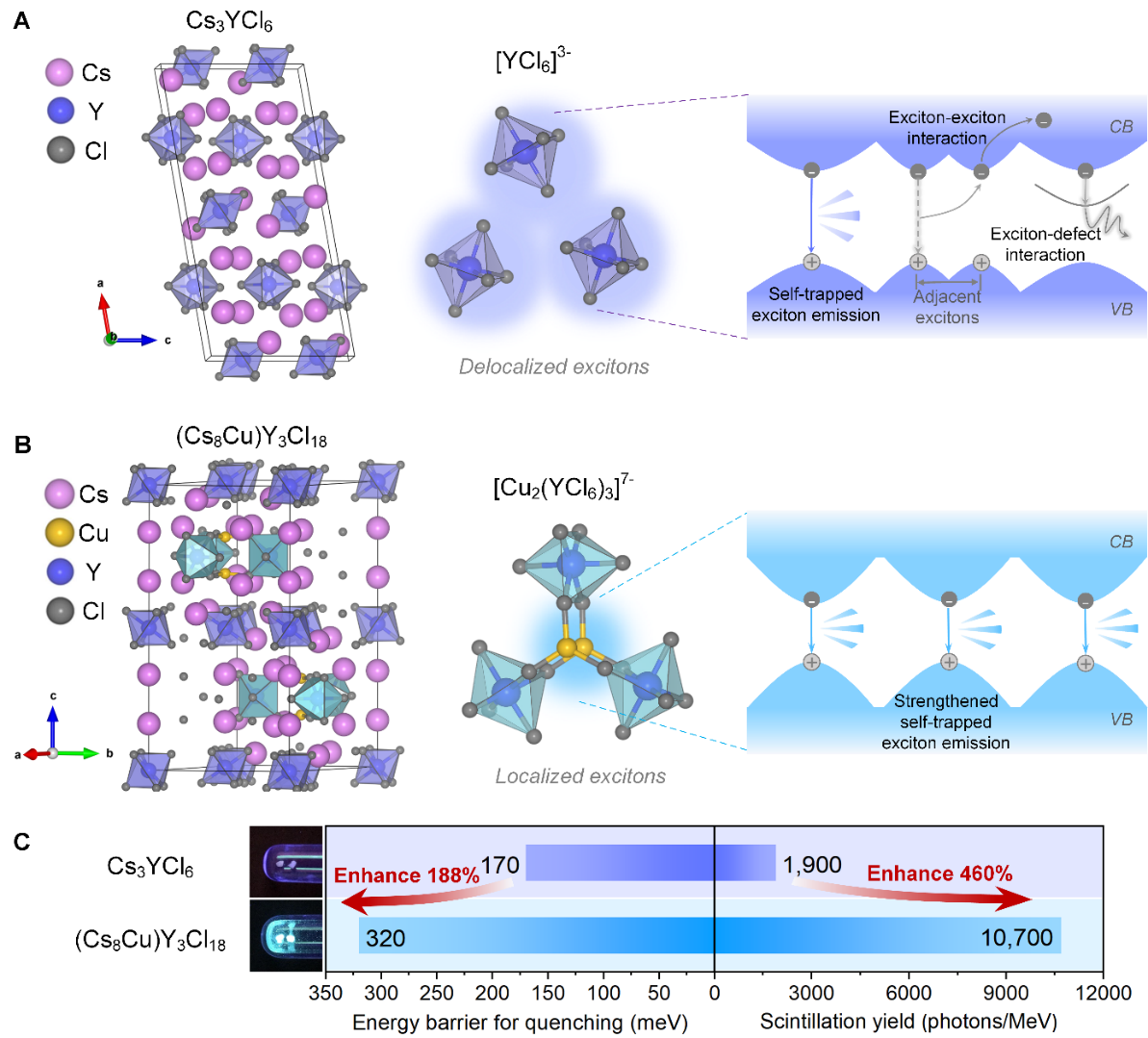
Figure 1. Strong Confined Exciton Luminescence in Low-Dimensional Metal Halides Achieved Through Structural Modulation
Links: https://spj.science.org/doi/10.34133/research.1230
Contact: Yuntao Wu
Shanghai Institute of Ceramics, Chinese Academy of Sciences
Published online: April 14, 2026