New Framework Unifies Cleavage and Slip in Fluorite Crystals
A research team at the Shanghai Institute of Ceramics, Chinese Academy of Sciences (SICCAS), has uncovered the atomic-scale mechanisms that determine whether fluorite-structured crystals fail by cleavage or deform by slip under stress. The findings were published in Acta Materialia.
Led by Dr. Shukuan GUO and Professor Liangbi SU, the team performed comprehensive first-principles calculations on fluorite-structured alkaline earth fluorides (MF₂, where M = Ca, Sr, Ba). Their work establishes a quantitative energy-based framework that links bonding characteristics to the competition between cleavage and slip in this important class of materials.
Fluorite-structured crystals include technologically critical materials such as uranium dioxide (UO2) for nuclear fuels, cerium dioxide (CeO2) for catalysis, and zirconium dioxide (ZrO2) for structural ceramics. These materials are known for their pronounced brittleness and a strong tendency to cleave along specific crystal planes. Yet under certain conditions, they can also exhibit plasticity through particular slip systems.
The team's calculations reveal why the {111} crystal plane is so prone to cleavage. This plane exhibits the lowest ideal tensile strength, the most restricted phonon instability strain, and the minimum cleavage energy among all low-index planes. In contrast, plastic flow is dominated by the {001}<110> slip system, which possesses the lowest shear strength and the lowest energy barrier for slip.
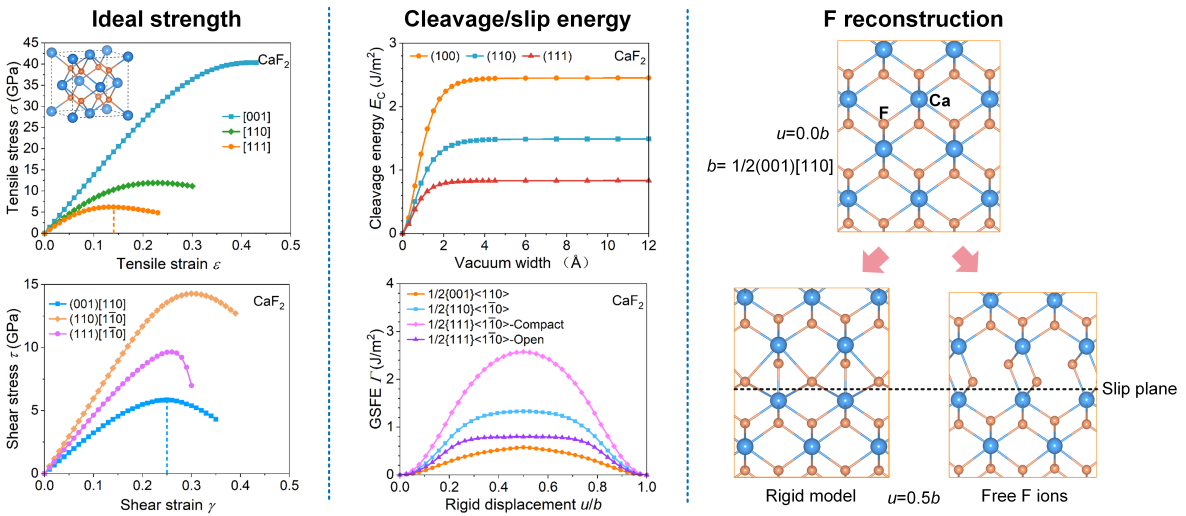
Figure 1. Mechanical anisotropy of CaF2 crystals and reduction of the slip barrier on the (100) plane by fluorine ion reconstruction on the slip plane.
The competition between cleavage and slip is quantified by a ratio: the cleavage energy divided by the slip energy barrier (EC/Γ). On the {111} and {110} planes, this ratio is approximately 1.0, meaning that breaking and bending require nearly the same energy—explaining the extreme brittleness observed on these planes. On the {001} plane, the ratio is markedly higher, above 3.8, indicating that bending is strongly favored over breaking. This finding is consistent with experimental observations of abundant slip-related dislocations on the {001} plane at both room and elevated temperatures. The researchers trace this fundamental deformation anisotropy to the unique bonding characteristics of the fluorite lattice. The directionality of metal-fluorine bonds, coupled with intense electrostatic repulsion between like-charged ions during shear, dictates the distinctive energetic landscape.
By establishing the crystal-plane-dependent EC/Γ criterion as a transferable predictive framework, this work provides a fundamental basis for understanding deformation mode selection across the broad family of fluorite-structured materials. The findings offer actionable strategies for enhancing mechanical reliability through texture engineering or compositional design.
Article link: https://doi.org/10.1016/j.actamat.2026.122141
Contact: Liangbi Su
Shanghai Institute of Ceramics, Chinese Academy of Sciences
E-mail: suliangbi@mail.sic.ac.cn
Available online: 17 March 2026