One-Step “Cleaving and Doping” Strategy Yields High-Performance Thermoelectric Polymers
A research article published in Angewandte Chemie International Edition presents a one-step "cleaving and doping" strategy that enhances the thermoelectric (TE) performance and stability of open-shell conjugated polymers. The research, demonstrates an approach to achieving highly ordered molecular packing and efficient doping without the need for additional dopants.
The research was led by Prof. Lidong CHEN and Prof. Hui LI of SICCAS, in collaboration with Prof. Jian SONG of Shanghai University. The first author of the paper is Yu XU, a master's candidate at SICCAS.
Open-shell conjugated polymers are considered promising for TE applications due to their unique electronic structures. However, their real-world use has been limited by structural disorder and poor stability in air and at high temperatures. To address these challenges, the researchers treated three benzo[1,2-c;4,5-c']bisthiazole (BBT)-based polymers with trifluoromethanesulfonic acid (TfOH). This acid simultaneously cleaves the polymers' silane side chains and dopes the backbone in situ.
The synergy between enhanced carrier mobility and optimized carrier concentration leads to remarkably improved thermoelectric performance compared to the corresponding alkyl polymer. Beyond performance, the side-chain-free films exhibit stability in air and at elevated temperatures, retaining their power factor after prolonged heating at 100°C for four hours.
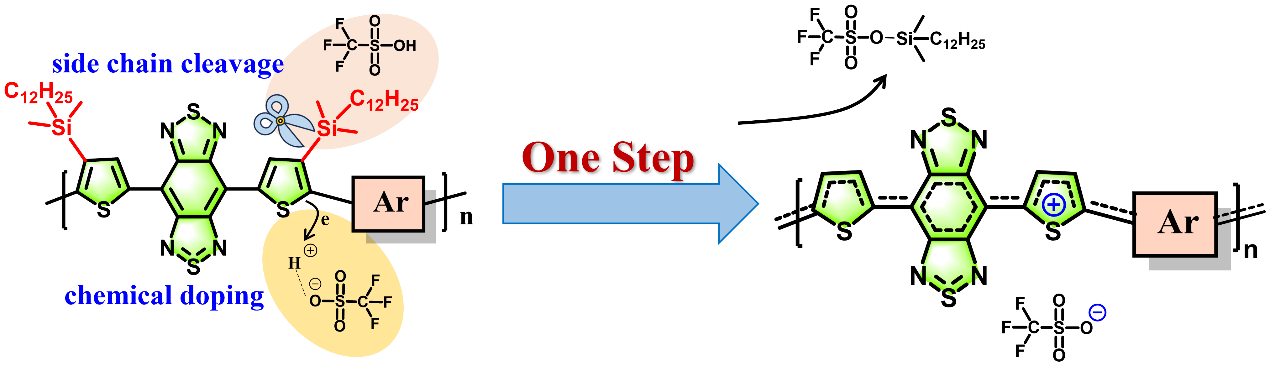
Figure 1. Schematic illustration of the one-step “cleaving and doping” strategy and molecular structures of the BBT-based polymers
Grazing incidence wide-angle X-ray scattering results reveal that the removal of side chains significantly reduces lamellar and π-π stacking distances, facilitating efficient intra- and intermolecular charge transport. Density functional theory calculations suggest that the TfO- anions are thermodynamically positioned near the positive potential of the thiophene units, effectively doping the polymer without disrupting the close chain packing. The dense and ordered molecular packing resulting from side-chain removal is the key factor responsible for the enhanced TE performance and stability.
This work demonstrates that one-step side-chain cleavage and in situ doping is a pathway to achieve stable and high-mobility conjugated polymer films, with potential applications extending beyond TEs to various organic electronic devices.
Links:
https://onlinelibrary.wiley.com/doi/10.1002/anie.4521405
Contact: Hui Li
Shanghai Institute of Ceramics, Chinese Academy of Sciences
E-mail: lihui889@mail.sic.ac.cn
Published online: March 9, 2026