Advanced Materials Reviews BiFeO₃-Based Sensors for Multifunctional Detection
A comprehensive review published in Advanced Materials provides a systematic assessment of BiFeO₃-based sensor technologies, examining how this multiferroic material can be engineered for high-performance sensing applications across multiple detection modes.
The review was led by Associate Professor Nan MA from the Shanghai Institute of Ceramics, Chinese Academy of Sciences (SICCAS). MA serves as the first author and co-corresponding author. Professor Kengo Shimanoe from Kyushu University, Japan, and Professor Ya YANG from the Beijing Institute of Nanoenergy and Nanosystems, Chinese Academy of Sciences, are co-corresponding authors.
The review systematically discusses the structure-property relationships of BiFeO₃ and summarizes recent advances in synthesis strategies and modification approaches. It further analyzes how these regulation methods influence the performance of different types of sensors, including photodetectors, pressure sensors, gas sensors, humidity sensors, and biosensors.
Particular attention is given to the key microscopic mechanisms governing sensing behavior. The authors examine three fundamental processes: band structure modulation that affects the material's response to optical and electrical stimuli, defect-mediated charge transport that influences sensitivity and response speed, and surface adsorption-driven interfacial chemical reactions that determine selectivity in gas and humidity sensing.
Based on these mechanistic insights, the review summarizes various strategies for improving sensor performance. These include strain engineering, compositional tuning through doping, and defect design—approaches that leverage BiFeO₃'s intrinsic multiferroic properties to achieve enhanced sensitivity, selectivity, and long-term stability.
Looking forward, the review highlights opportunities for BiFeO₃-based sensors in practical applications. The material's unique multi-field coupling and multifunctional characteristics make it particularly suitable for use in environmental monitoring, healthcare and biomedical diagnostics, industrial automation, and energy systems. As demand grows for high-performance multifunctional sensors in these fields, the review provides a clear understanding of both current capabilities and future opportunities, serving as a valuable resource for researchers and engineers working on next-generation sensing technologies.
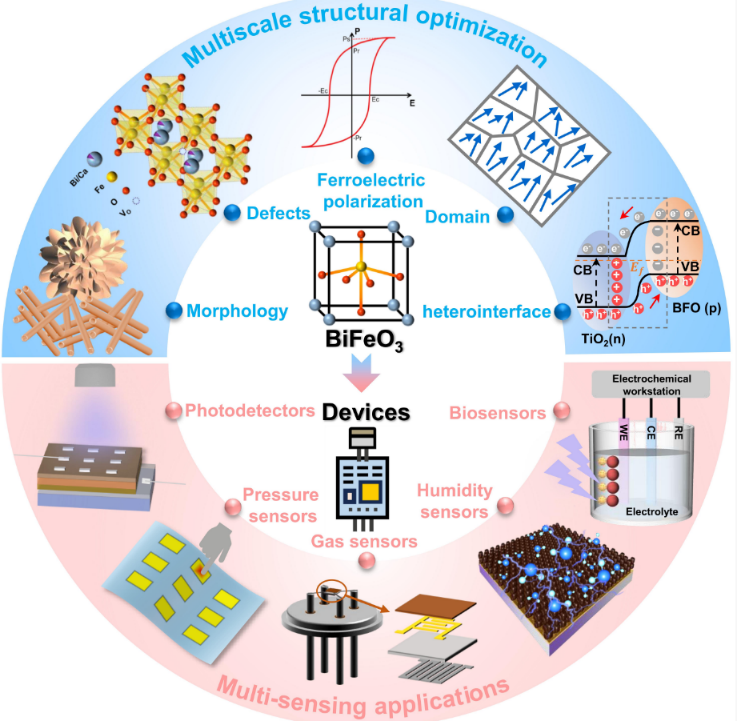
Figure 1. Structure-property-device relationships and multifunctional sensing applications of BFO.
Article link:https://doi.org/10.1002/adma.202520682
Contact: Nan Ma
Shanghai Institute of Ceramics Chinese Academy of Sciences
E-mail: manan@mail.sic.ac.cn
上线时间:2026年2月7日